 Skip to content


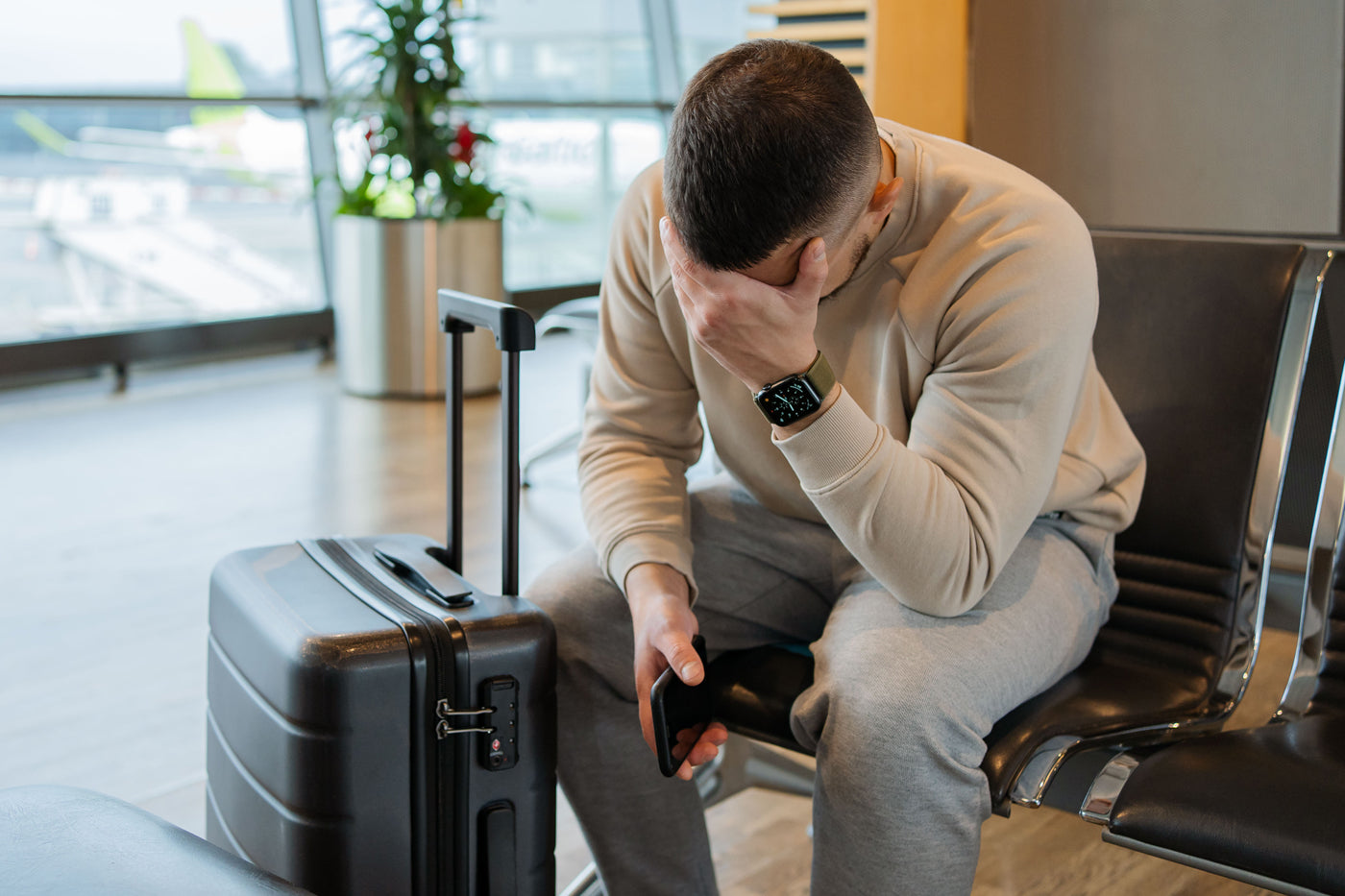
Traveling across time zones doesn’t just disrupt your sleep—it temporarily confuses your brain’s internal clock. The good news is that understanding how your brain keeps time can help you recover from jet lag more quickly and get back to feeling like yourself.
Whether you’re traveling for business, vacation, or an important family event, jet lag can leave you feeling foggy, tired, irritable, and wide awake at exactly the wrong time. Most advice focuses on getting more sleep.
That’s true.
But here’s the part almost nobody talks about.
Jet lag isn’t really a sleep problem.
It’s a brain timing problem.
Let me explain.
Deep inside your brain is a tiny cluster of cells that acts as your body’s master clock. This cluster of cells tells you when to feel alert, when to get sleepy, when to release hormones, and even when it’s time to eat.(1)
When you suddenly cross several time zones, that clock doesn’t instantly reset just because your airplane landed. Your watch may say it’s 8 a.m. in Paris, but your brain is still convinced it’s midnight in Los Angeles.
Your passport arrived hours ago. Your brain hasn't yet.
That’s why jet lag feels so strange.
Your brain is still living yesterday while the rest of the world has already moved on.
The encouraging news is that your brain is remarkably adaptable.
Once you understand what it’s waiting for—and the signals it uses to tell time—you can help it adjust faster. That means less brain fog, better sleep, steadier energy, and a much quicker return to feeling mentally sharp.
At a Glance
- Jet lag happens because your brain’s internal clock is out of sync with the local time—not simply because you lost sleep.
- The brain’s “master clock” responds primarily to light, but meal timing, activity, and melatonin also help reset your internal rhythm.
- Traveling east is usually harder than traveling west because it’s generally easier for the brain to stay up later than to fall asleep earlier.
- Most people need about one day to fully adjust for each time zone crossed, although smart strategies can often speed the process.
- Supporting healthy sleep, hydration, and cognitive function may help your brain adapt more comfortably while traveling.
Why Your Brain Gets Jet Lag
Think of your brain as having its own built-in timekeeper.
Scientists call it the suprachiasmatic nucleus—mercifully abbreviated the SCN. It’s a tiny cluster of about 20,000 nerve cells located deep in the brain, but don’t let its size fool you. Think of it as the conductor of your body's biological orchestra.(2)
Without ever taking center stage, it keeps sleep, hormones, body temperature, energy levels, and countless other biological rhythms playing in sync.
- Sleep and wakefulness.
- Body temperature.
- Hormone production.
- Energy levels.
- Even aspects of memory, attention, and reaction time.
Remember, your brain doesn’t wear a watch.
Instead, it figures out what time it is by paying attention to signals from the outside world. The most important signal—by far—is light. Morning sunlight tells your brain, “A new day has begun.” Darkness sends the opposite message.
Scientists call these time-setting signals zeitgebers, a German word that literally means “time givers.” Fortunately, you don't have to remember the word. Just remember what it means: your brain is constantly looking for clues about what time it is.
When you fly across six, eight, or ten time zones in a matter of hours, those signals suddenly stop making sense.
Your eyes are telling your brain one thing.
Your internal clock is insisting on another.
That’s what creates the mental tug-of-war we call jet lag.(3)
The result isn’t just feeling sleepy at odd hours. Your brain is temporarily trying to run on Flintstones time in a Jetsons world. Until it catches up, you may find it harder to concentrate, remember things, think clearly, or stay energized—even if you’ve managed to get a decent night’s sleep.
Understanding that changes the way you think about recovering from jet lag.
The goal isn’t simply to get more sleep.
It’s to help your brain learn what time it is.
Why Flying East Usually Feels Worse Than Flying West
Have you ever noticed that flying from Los Angeles to Paris can leave you feeling like you’ve been hit by a truck, while the trip home is often a little easier?
That’s not your imagination.
It’s biology.(4)
Your internal clock naturally runs just a little longer than 24 hours. As a result, it’s generally easier for your brain to delay bedtime than to move it earlier.
Think about it.
Most of us have stayed up until midnight—or later—without too much trouble.
But how easy is it to fall asleep at 7:30 in the evening because you have an early flight the next morning?
Exactly.
Traveling west usually asks your brain to stay awake a little longer. Traveling east asks it to fall asleep before it’s ready. For most people, that’s the tougher assignment.
That’s why a flight to Europe often feels more disruptive than the return trip home.
Another rule of thumb is surprisingly accurate: your brain generally needs about one day for every time zone crossed to fully adjust. Cross six time zones, and it may take close to six days before your internal clock is completely synchronized again.(5)
The good news?
You don’t have to sit back and wait.
Your brain is constantly looking for clues about what time it is. The more clearly you provide those clues, the faster it can reset its internal clock.
And that brings us to the single most powerful signal your brain pays attention to.
Brain Bonus: Are You a Morning Lark or a Night Owl?Not everyone experiences jet lag the same way. Part of the reason is something called your chronotype—your natural tendency to be an early bird ("morning lark") or a night owl.(13) Morning larks naturally wake up and feel their best earlier in the day. Night owls naturally prefer later bedtimes and later wake-up times. That difference matters when you travel. Because flying east requires your brain to fall asleep earlier than usual, morning larks often adapt a little more easily. Night owls, whose internal clocks naturally run later, may find eastbound travel especially challenging. Flying west is often the opposite. Since it asks your brain to stay awake longer, many night owls adjust more comfortably than early risers. Of course, chronotype is only one piece of the puzzle. Your age, the number of time zones crossed, exposure to daylight, meal timing, and your overall sleep habits all influence how quickly your brain resets. The encouraging news is that no matter which chronotype you are, your brain uses the same time-setting signals—especially light—to gradually synchronize with your new destination. |
Light: The Fastest Way to Reset Your Brain's Clock
If your brain had to choose just one piece of information to figure out what time it is, it would choose light.
Every time.
That's because special cells in your eyes are constantly measuring the amount of light around you and sending that information directly to your brain's master clock. It's one of the reasons getting outside for a few minutes in the morning can wake you up better than another cup of coffee.
Your brain interprets bright morning light as a clear message:
"It's daytime. Let's get today's schedule started."
Evening darkness sends the opposite message, telling your brain it's time to begin winding down.
That's why light is considered the most powerful "reset button" for your circadian rhythm.(6)
If you're traveling east, getting outside in the local morning sunlight can help convince your brain to shift earlier. If you're traveling west, a little extra light later in the day may help your brain comfortably stay on the new schedule.
You don't have to stare at the sun or spend hours outdoors.
Simply getting outside for 20 to 30 minutes—especially within the first hour or two after waking—can provide a surprisingly strong signal that helps your brain begin adapting to local time.
Light doesn't work because it makes you feel more awake.
It works because it tells your brain what time it is.
Once your brain starts believing the new schedule, everything else begins to fall into place.
Brain Boost
Morning sunlight is one of the most powerful ways to help your brain adjust to a new time zone. Pairing that with consistent sleep habits, good hydration, and nutrients that support healthy brain function can make the transition even smoother. Products such as BrainMD Smart Hydration™ can help replace fluids and electrolytes lost during long flights, supporting energy and mental performance while your brain adapts to its new schedule.(7)
The Other Signals Your Brain Uses to Tell Time
Light may be the star of the show.
But it isn't the only actor.
Your brain is constantly gathering information from the rest of your body, looking for clues that confirm—or contradict—what your eyes are telling it.
One of those clues is when you eat.
If your body has been eating dinner at 7 p.m. Los Angeles time for the past six months, and suddenly dinner shows up at what your brain thinks is 10 a.m., it's understandably a little confused. Eating your meals on the local schedule helps reinforce the message that you've entered a new time zone.(8)
Movement sends a similar signal.
You don't need to run a marathon after a long flight. In fact, that may be the last thing you feel like doing. But a brisk walk, a visit to the hotel gym, or even a few minutes of stretching tells your brain that it's time to be awake and engaged with the new day.(9)
Hydration matters, too—but for a different reason.
Dehydration doesn't cause jet lag.
What it does do is magnify many of the symptoms people already associate with jet lag, including fatigue, headaches, and difficulty concentrating. Airplane cabins are notoriously dry, so arriving well hydrated gives your brain one less obstacle to overcome.(7)
Finally, there's melatonin.
Melatonin isn't a sleeping pill. It's a hormone your brain naturally produces as darkness falls. Think of it less as something that knocks you out and more as a biological announcement that nighttime has arrived.
When used appropriately—and timed correctly—melatonin may help some travelers adjust more quickly to a new time zone, particularly after eastbound travel. Timing is important, though, which is why many sleep experts recommend taking it close to your target bedtime in your destination rather than according to the time back home.(10)
Notice the pattern?
- Light.
- Meals.
- Movement.
- Melatonin.
They're all speaking the same language.
Each one is simply another way of telling your brain: "This is what time it is now."
Why Jet Lag Makes You Feel So Foggy
One of the most frustrating parts of jet lag isn’t being sleepy.
It’s feeling like your brain has been wrapped in cotton.
You walk into a room and forget why.
You reread the same paragraph three times.
Someone asks you a simple question and your brain answers, “Can we get back to you on that?”
That’s because your internal clock doesn’t regulate only sleep.
It also helps coordinate attention, memory, reaction time, mood, and mental performance. When that timing system is temporarily out of sync, those mental processes can become less efficient.
Researchers have found that circadian disruption can affect everything from memory formation to reaction time, helping explain why jet lag feels as much like a thinking problem as a sleeping problem. (11)
The important thing to remember is that nothing is “wrong” with your brain.
It’s just working from the wrong schedule.
Once your internal clock begins synchronizing with local time, mental sharpness usually returns right along with it.
That’s one reason it’s worth resisting the temptation to fight your body’s signals. Sleeping all day, eating at random hours, or hiding in a dark hotel room may feel comforting in the moment, but it can send mixed messages to the very system that’s trying to recalibrate itself.
Your brain wants consistency.
The clearer the signals you give it, the faster it can get back on schedule.
Brain Boost
Jet lag doesn’t just affect sleep—it can temporarily affect focus, attention, and mental clarity. If you’re traveling for an important meeting, competition, or family event, supporting cognitive health may be just as important as getting a good night’s sleep. BrainMD Smart Mushrooms contains clinically studied mushrooms traditionally used to support cognitive function and overall brain health, making it a thoughtful addition to your travel routine.(12)

Putting It All Together: A Simple Game Plan for Faster Jet Lag Recovery
By now you’ve probably noticed something.
None of these strategies works by “treating” jet lag.
They work by helping your brain answer one simple question:
What time is it?
The more consistently you answer that question, the faster your brain can adjust.
Here’s what that might look like after you arrive:
- Get outside in natural daylight as soon as it’s practical.
- Eat your meals on local time, even if your appetite hasn’t quite caught up yet.
- Move your body. A walk around the neighborhood or a light workout is usually enough.
- Stay hydrated throughout the day, especially after a long flight.
- And when appropriate, consider melatonin at your destination’s bedtime—not your departure city’s.
None of these steps is magic by itself.
Together, though, they send your brain the same message from multiple directions.
“You’re here now.”
One final thought.
Don’t be discouraged if you don’t feel completely normal the first morning after you land. Your brain isn’t malfunctioning. It’s doing exactly what evolution designed it to do: protect a carefully tuned biological rhythm.
It simply needs a little time—and the right signals—to establish a new normal.
The remarkable thing is how quickly it usually does.
Once your brain’s internal clock catches up with your passport, you’ll often notice that your energy returns, your thinking becomes clearer, and sleep starts feeling natural again.
Your trip doesn’t change because your watch says you’re in a different country.
It changes because your brain finally agrees.
The Bottom Line
Jet lag is one of those experiences that seems inevitable.
To a point, it is.
You can’t fly across eight time zones and expect your brain to pretend nothing happened.
But you can make the adjustment easier.
The key is understanding what your brain is trying to accomplish.
It’s not trying to make you miserable.
It’s trying to synchronize thousands of biological processes—from sleep and hormone production to attention, mood, and energy—with the world around you. Until that happens, feeling “off” is a perfectly normal response.
Fortunately, your brain is also remarkably adaptable.
Give it the right information—morning light, consistent meal timing, regular movement, good hydration, and healthy sleep habits—and it usually knows exactly what to do.
That’s the real secret to getting over jet lag.
You’re not fighting your brain.
You’re working with it.
Frequently Asked Questions
How long does jet lag usually last?
A good rule of thumb is about one day for each time zone crossed, although some people recover more quickly and others take a bit longer. Factors such as age, chronotype (“morning lark” versus “night owl”), travel direction, and exposure to daylight all influence how quickly your brain adjusts.
Is flying east really worse than flying west?
For most people, yes. Your brain generally finds it easier to stay awake a little longer than to fall asleep earlier. That’s why eastbound travel often produces more noticeable jet lag than westbound trips.
What’s the fastest way to recover from jet lag?
There’s no instant cure, but getting morning daylight, eating meals on the local schedule, staying physically active, maintaining good hydration, and following local bedtime all help your brain adapt more quickly.
Does melatonin really work for jet lag?
Research suggests that melatonin can be helpful for some travelers, particularly after eastbound flights. The timing matters. It’s generally most effective when taken close to bedtime at your destination rather than according to your home time zone.
Why do I feel mentally foggy after a long flight?
Jet lag disrupts your brain’s circadian timing system, which influences much more than sleep. Attention, memory, reaction time, and mental clarity can all temporarily decline until your internal clock adjusts to the new time zone.
Can dehydration make jet lag worse?
While dehydration doesn’t cause jet lag, it can make many of its symptoms—including fatigue, headaches, and difficulty concentrating—feel more intense. Drinking enough fluids before, during, and after your flight can help you feel better overall.
Can BrainMD supplements help support recovery?
No supplement can eliminate jet lag, because your brain still needs time to adjust to a new light-dark cycle. However, products that support healthy sleep, hydration, energy production, and cognitive function may help you feel more comfortable while your brain makes that transition. Used alongside healthy travel habits—not instead of them—they can be a valuable part of your travel routine.
At BrainMD, we’re dedicated to providing the highest quality supplements to improve your physical health and overall well-being. For more information about our full list of brain healthy supplements, please visit us at BrainMD.
These statements have not been evaluated by the FDA. This content is for informational purposes only. It is not meant to substitute for medical or healthcare advice from a physician, nor is it intended to diagnose, treat, cure, or prevent any disease. Consult your healthcare provider before beginning a new health regimen.
REFERENCES
- Desai, D., et al (2024) Exploring the role of Circadian rhythms in Sleep and Recovery: A Review Article Cureus 2024 Jun 3;16(6):e61568. https://pmc.ncbi.nlm.nih.gov/articles/PMC11221196/
- Patton, AP, Hastings, MH (2018) The suprachiasmatic nucleus Current Biology Volume 28, Issue 15, 6 August 2018, Pages R816-R822 https://www.sciencedirect.com/science/article/pii/S0960982218308431
- Baron, KG, Reid, KJ (2015) Circadian Misalignment and Health Int Rev Psychiatry, Apr;26(2):139–154. doi: 10.3109/09540261.2014.911149
- May Smith, Why jet log is worse when you're traveling east, Science 19, July 2016
- Jasper, SC, et al (2022) Travel across time zones and the implications for human performance post pandemic: Insights from elite sport Front Public Health Dec 2;10:998484. doi: 10.3389/fpubh.2022.998484
- M, Bromundt, V (2012) Light and chronobiology: implications for health and disease Dialogues Clin Neurosci Dec;14(4):448–453. doi: 10.31887/DCNS.2012.14.4/mmuench
- Zubac, D, Alex Stella. A B, Morrison, SA (2020) Up in the Air: Evidence of Dehydration Risk and Long-Haul Flight on Athletic Performance Nutrients,Aug 25;12(9):2574. doi: 10.3390/nu12092574
- Adafer, R, et al (2020) Food Timing, Circadian Rhythm and Chrononutrition: A Systematic Review of Time-Restricted Eating’s Effects on Human Health Nutrients Dec 8;12(12):3770. doi: 10.3390/nu12123770
- Shen, B, et al (2023) Effects of exercise on circadian rhythms in humans Front Pharmacol Oct 11;14:1282357 doi: 10.3389/fphar.2023.1282357
- Herxheimer, A, Petrie, K (2002) Melatonin for the prevention and treatment of jet lag Cochrane Database Syst Rev Apr 22;2002(2):CD001520. doi: 10.1002/14651858.CD001520
- Richardson MES, et al (2020) Jet Lag Recovery and Memory Functions Are Correlated with Direct Light Effects on Locomotion J Biol Rhythms Dec;35(6):588-597. doi: 10.1177/0748730420947589. Epub Sep 2.
- Docherty, S., et al (2023) The Acute and Chronic Effects of Lion’s Mane Mushroom Supplementation on Cognitive Function, Stress and Mood in Young Adults: A Double-Blind, Parallel Groups, Pilot Study Nutrients Nov 20;15(22):4842.
- Vahdatpour, C et al (2026) Morning Larks and Night Owls: Considering Chronotype in Evaluation of Patients with Pulmonary Hypertension, Ann Am Thorac Soc. 2026 Feb 1;23(2):261–271. doi: 10.1513/AnnalsATS.202502-190OC
