 Skip to content


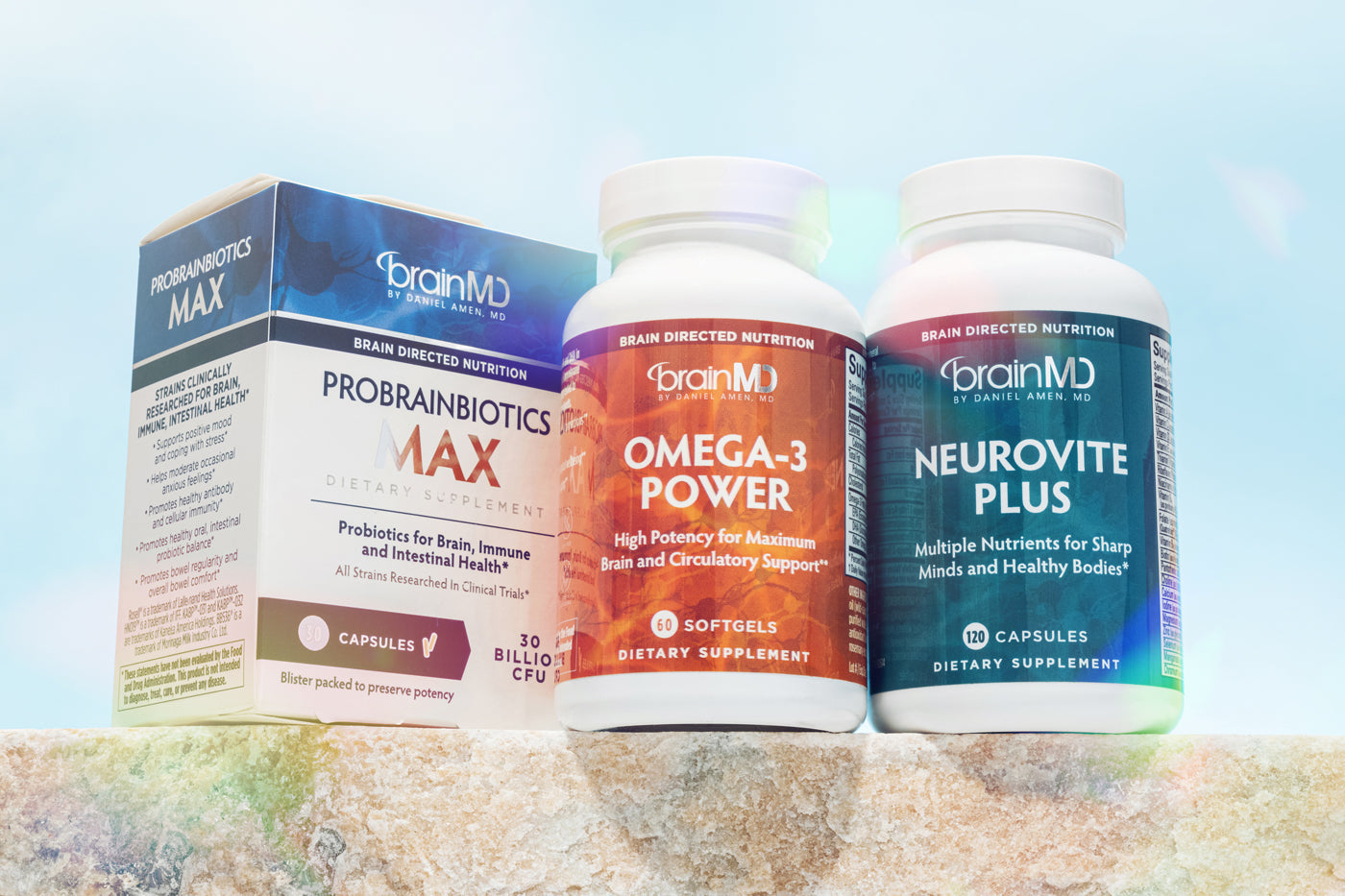
If you've spent any time looking into Dr. Amen supplements, you've probably noticed something: the list of nutrients, botanicals, and targeted formulations for different brain health goals is long. However, before he ever recommends nootropics, adaptogens, or specialty blends for unique needs, he starts in the same place every time. Three basics:
- A multivitamin
- An omega-3
- A probiotic
After decades of scanning brains at Amen Clinics and reviewing what actually supports positive changes to cognitive health, Dr. Amen keeps coming back to the same foundation because it works. Most people (even health-conscious ones) are unknowingly missing the basics.
If you're the kind of person who reads ingredient labels, asks your doctor real questions, and wants to feel sharp at 45, 65, or 105, this is worth understanding. Not as a sales pitch, but as an actual explanation of why these three categories earn their spot at the front of the line in Dr. Amen’s favorite supplement list.
Why Start Here?
Yes, BrainMD® offers products that can provide extra support for things like focus, energy, blood-sugar control, or physical performance. But, your brain, like the rest of your body, requires some fairly unglamorous inputs for baseline function: it needs a full set of vitamins and minerals to run its chemistry, fat (specifically the right kind of fat) to build and maintain its physical structure, and a functioning gut, because your gut and brain are in constant conversation with each other.
Skip any of those three, and the powerful additions you layer on top can’t function to their full potential.
That's the logic behind BrainMD's foundational lineup, and it's why products like NeuroVite Plus Multivitamin, Omega-3 Power, and ProBrainBiotics show up again and again as Dr. Amen's favorite supplements.
Step One: A Real Multivitamin
Most multivitamins are built for general wellness, aimed at the broadest possible audience. NeuroVite Plus was built differently, for people who know brain health is the basis for whole body health. It contains the vitamins, minerals, and cofactors your brain specifically draws on to make neurotransmitters, manage inflammatory balance, and keep cellular energy production running. They’re also included in forms that your body can readily absorb and use, which can’t be said for all multivitamins.
If you’re looking for even more comprehensive brain health support, BRIGHT MINDS™ Memory Multi is a great alternative product. Instead of a capsule, it’s a powdered full spectrum multivitamin and mineral formula, combined with active botanicals, antioxidants, and other nutrients clinically shown to support numerous aspects of memory, mood, and cognition.*
In a large, three-year randomized trial following more than 2,000 older adults, daily multivitamin-mineral supplementation was associated with meaningfully better performance on measures of memory and executive function compared to placebo. It was the first large-scale study to suggest multivitamin use may help slow age-related cognitive changes [1].
A follow-up analysis comparing that trial with two others found the same pattern held up: better global cognition and episodic memory with daily multivitamin use [2].
None of this means a multivitamin is a substitute for medical care. What it does mean is that "just take a multivitamin" isn't throwaway advice.
Nutrient gaps are common even in people who eat a well balanced diet, and a well-formulated multivitamin is one of the simplest ways to close them.
Step Two: Omega-3s, Because Your Brain Is Mostly Fat
Here's a fact that surprises people: your brain is close to 60% fat, and DHA (one of the two main omega-3s) is one of its primary structural building blocks. Your body doesn't make much of it on its own. It has to come from diet or supplementation, and most Americans simply don't eat enough fatty fish to get there.
Omega-3 Power is BrainMD's answer to that gap, formulated with significantly more DHA and EPA per serving than most drugstore fish oil. The dosing isn't arbitrary. In the MIDAS trial, a randomized, placebo-controlled study of 485 older adults with mild memory complaints, six months of daily DHA supplementation led to meaningfully better performance on tests of learning and memory compared to placebo, an effect researchers likened to shaving several years off the participants' cognitive age [3].
Broader reviews of omega-3 research have also linked long-term supplementation to better-preserved white matter and gray matter volume over time [4].
Fish oil isn't a cure-all, and results across the broader research base are mixed. Some trials, especially shorter ones in people who already eat fish regularly, show smaller effects. But for the average person whose diet is genuinely low in omega-3s, topping up that supply appears to give the brain more of the literal material it needs to maintain its structure.
Step Three: The Oft-Forgotten Probiotic
This is the piece that catches most people off guard. What does gut bacteria have to do with brain fog or mood?
More than you'd think. Your gut and brain are connected by a direct communication line, sometimes called the gut-brain axis, that runs through the vagus nerve, the immune system, and a whole slew of chemical messengers your gut bacteria help produce [5].
Plus, roughly 70% of your immune system actually lives in your gut, which means an out-of-balance microbiome doesn't just affect digestion, it can ripple into the inflammatory processes tied to mood and cognitive function [6].
This is exactly the territory "psychobiotics" (probiotic strains specifically studied for their effect on this gut-brain communication) were termed to describe [7]. In one randomized trial, a specific combination of Lactobacillus and Bifidobacterium strains was associated with a more balanced stress response and lower markers of stress in healthy adults over several weeks [8].
A broader review of more than fifty clinical trials found consistent signals of benefit from psychobiotic strains, particularly around mood-related outcomes [9].
ProBrainBiotics was formulated with this research in mind. It was built around strains studied specifically for gut-brain communication, not just general digestive support. For anyone who's diligent about diet and exercise, but has never thought about their microbiome, this is often the missing third leg of the stool.
Putting Your Stack Together
None of these three does its job in isolation. A multivitamin without enough dietary fat still leaves your brain short on raw building material. An omega-3 without the cofactors a multivitamin provides has less support for the metabolic work of actually using that fat well. And a gut under chronic inflammatory imbalance makes it harder for either one to do its job efficiently, because so much of the communication between body and brain runs straight through it.
That's the logic behind treating these three as a foundation. Of course, you are encouraged to build outward from here. Some of Dr. Amen’s other personal favorite supplements are:
- Happy Saffron Plus® for mood and emotional well-being*
- Smart Mushrooms for mental performance and immune support*
- Smart Relief for body comfort and joint mobility*
- Peak Energy for a fast-acting alternative to caffeine*
Adaptogens, superfoods, nootropics, whatever fits your specific goals, most products in the BrainMD line are complementary to the foundational products. Just don’t skip the base 3.
If you're not sure where your own gaps might be, or where your brain and body could use a little extra boost, BrainMD's Brain Health Assessment is a great starting point. It takes about 5 minutes and you learn your brain type (there are 16 types), which will guide you to the best specific products for your unique needs.
BrainMD’s full supplement collection is organized by health goal (focus, mood, sleep, memory, etc.) if you want to go beyond the basics once your foundation is in place.
As always, talk with your doctor before starting any new supplement, especially if you're pregnant, nursing, managing a health condition, or taking prescription medication. Supplements are meant to complement, not replace, healthy habits (good sleep, regular movement, real food) and medical care when you need it.
*These statements have not been evaluated by the Food and Drug Administration. These products are not intended to diagnose, treat, cure, or prevent any disease.
References
-
Baker, L. D., Manson, J. E., Rapp, S. R., Sesso, H. D., Gaussoin, S. A., Shumaker, S. A., & Espeland, M. A. (2022). Effects of cocoa extract and a multivitamin on cognitive function: A randomized clinical trial. Alzheimer's & Dementia. https://doi.org/10.1002/alz.12767
-
Vyas, C. M., Manson, J. E., Sesso, H. D., et al. (2024). Effect of multivitamin-mineral supplementation versus placebo on cognitive function: Results from the clinic subcohort of the COSMOS randomized clinical trial and meta-analysis of 3 cognitive studies within COSMOS. The American Journal of Clinical Nutrition.
-
Yurko-Mauro, K., McCarthy, D., Rom, D., Nelson, E. B., Ryan, A. S., Blackwell, A., Salem, N., Jr., & Stedman, M. (2010). Beneficial effects of docosahexaenoic acid on cognition in age-related cognitive decline. Alzheimer's & Dementia, 6(6), 456–464. https://doi.org/10.1016/j.jalz.2010.01.013
- Shahinfar, H., Yazdian, Z., Avini, N. A., Torabinasab, K., & Shab-Bidar, S. (2025). A systematic review and dose response meta analysis of Omega 3 supplementation on cognitive function. Scientific Reports, 15(1), 30610.
-
Bonaz, B., Bazin, T., & Pellissier, S. (2018). The vagus nerve at the interface of the microbiota-gut-brain axis. Frontiers in Neuroscience, 12, Article 49. https://doi.org/10.3389/fnins.2018.00049
-
Belkaid, Y., & Hand, T. W. (2014). Role of the microbiota in immunity and inflammation. Cell, 157(1), 121–141. https://doi.org/10.1016/j.cell.2014.03.011
-
Dinan, T. G., Stanton, C., & Cryan, J. F. (2013). Psychobiotics: A novel class of psychotropic. Biological Psychiatry, 74(10), 720–726. https://doi.org/10.1016/j.biopsych.2013.05.001
-
Messaoudi, M., Lalonde, R., Violle, N., Javelot, H., Desor, D., Nejdi, A., Bisson, J.-F., Rougeot, C., Pichelin, M., Cazaubiel, M., & Cazaubiel, J.-M. (2011). Assessment of psychotropic-like properties of a probiotic formulation (Lactobacillus helveticus R0052 and Bifidobacterium longum R0175) in rats and human subjects. British Journal of Nutrition, 105(5), 755–764. https://doi.org/10.1017/S0007114510004319
-
Mosquera, F. E. C., Lizcano Martinez, S., & Liscano, Y. (2024). Effectiveness of psychobiotics in the treatment of psychiatric and cognitive disorders: A systematic review of randomized clinical trials. Nutrients, 16(9), Article 1352. https://doi.org/10.3390/nu16091352
